











500 hPa Geopotential Maps: Practical Guide
If you already master surface maps, it's time to take the next step. Geopotential maps at 500 hPa allow you to see "the engine" of the atmosphere, the current that actually governs the weather we'll have in the coming days. It's the tool that professional meteorologists use for medium-range forecasts.
What is Geopotential at 500 hPa?
Imagine you go up in a balloon until the barometer reads exactly 500 hectopascals (approximately 5,500 meters altitude). Geopotential is the height at which you'll find that pressure level at different points on the planet.
Why 500 hPa?
- It's approximately halfway in mass between the surface and space
- It's where the systems that determine our weather form and evolve
- It's above the direct influence of terrain
- It's the level where planetary waves that steer weather are best seen
Basic Elements of a 500 hPa Map
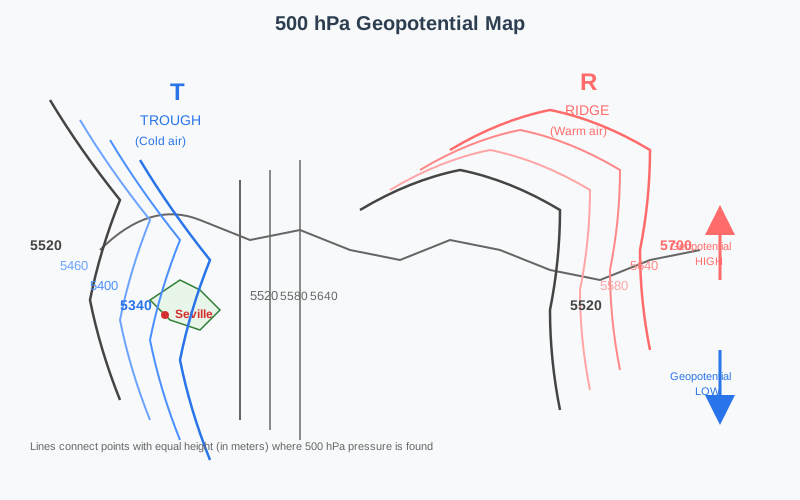
1. Geopotential Lines
Each line represents a specific height measured in geopotential meters (you may see the abbreviations "gpm" or "dam" meaning decameters, but it's clearer to speak directly of meters). Typical values: 5,400, 5,460, 5,520, 5,580 meters.
- Lines usually go in 60-meter intervals (every 6 decameters or "dam")
- When you read "5,520 dam" on a map, simply think of 5,520 meters
- High values (5,700-5,900 m): Warm air, anticyclonic weather
- Low values (5,200-5,400 m): Cold air, unstable weather
2. Troughs
A trough is an area where geopotential lines form a "U" or "V" pointing toward lower values. Think of it as a "valley" in the upper atmosphere.
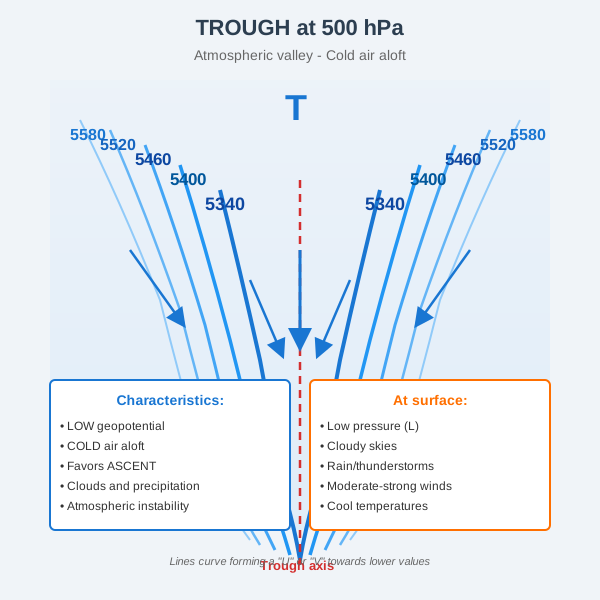
- ⬇️ Lower geopotential = colder air aloft
- 🌀 Favors air ascent and cloud formation
- 🌧️ Associated with bad weather, rain and instability
- 💨 Increases upper-level wind speed
- 📉 At the surface usually corresponds with low pressure
3. Ridges
A ridge is the opposite: lines form an "Ω" (omega) or crest pointing toward higher values. It's an atmospheric "mountain".
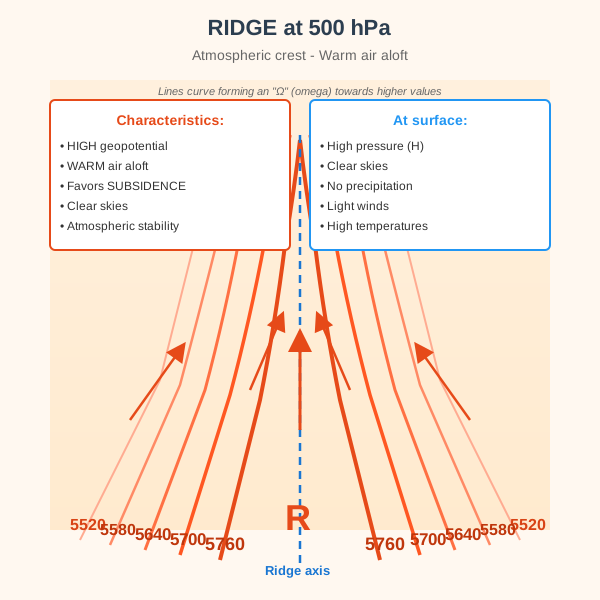
- ⬆️ Higher geopotential = warmer air aloft
- ⬇️ Favors subsidence (descending air)
- ☀️ Clear skies and stable weather
- 🌡️ Higher than normal temperatures
- 📈 At the surface usually corresponds with high pressure
4. The Jet Stream
Many 500 hPa maps overlay isotachs (lines of equal wind speed). Areas with very strong winds (>80 kt or 150 km/h) mark the jet stream.
Types of 500 hPa Configurations
Zonal Flow (West-East)
Geopotential lines are nearly parallel, oriented west to east, without major undulations.
Impact on Seville:
- Rapid passage of Atlantic storms
- Variable but predictable weather
- Frequent but moderate precipitation
- Typical of autumn-winter
Meridional Flow (With Pronounced Troughs and Ridges)
Lines form large north-south waves. There are deep troughs and marked ridges.
Impact on Seville:
- More extreme and long-lasting situations
- Persistent anticyclonic blocks
- Or heavy rainfall if a deep trough enters
- Lower predictability
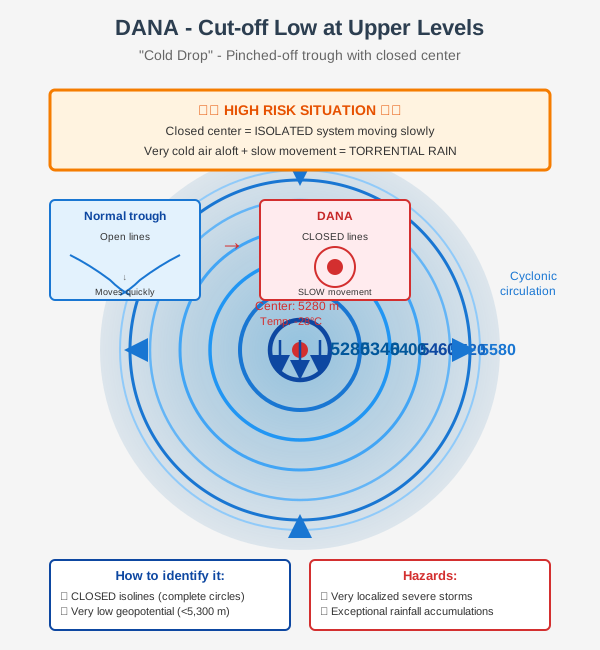
Cut-off Low or DANA
A trough that "pinches off" and becomes isolated from the main flow, forming a closed low geopotential center.
Impact on Seville:
- 🌍 Phenomenon mainly MEDITERRANEAN (Valencia, Murcia, Alicante)
- 📍 Seville rarely affected (Atlantic orientation)
- ⚡ If Atlantic DANA occurs: severe instability but infrequent
- 🔄 Slow and unpredictable movement
- ⚠️ In the Mediterranean: risk of torrential rains
Tropopause Descent: The Secret of the Most Adverse Situations
Before continuing, you need to understand a crucial concept that explains why some situations are so dangerous.
What Does It Mean for It to Descend?
When an extremely cold air mass descends from very high levels (even from the lower stratosphere), it drags the tropopause down with it. It's as if the "ceiling" of the active atmosphere descended.
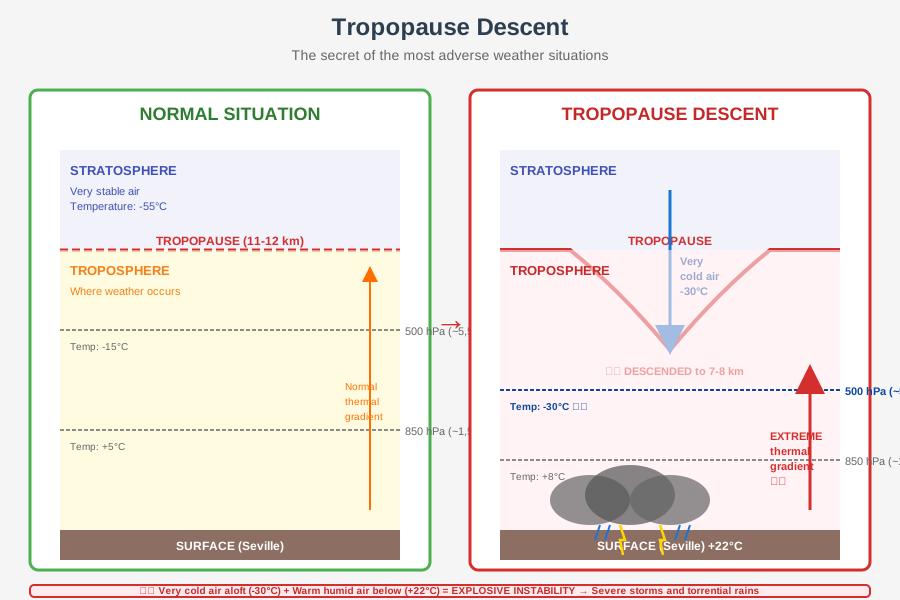
How Do We Detect It on a 500 hPa Map?
- ❄️ Very cold temperatures at 500 hPa: -30°C or lower (in summer, any temperature below -20°C is already very cold)
- 📉 Exceptionally low geopotential: Below 5,300 meters in summer, or 5,200 m in winter
- 🎯 Very compact core: Very tight contour lines at the center of the trough or DANA
- ⚡ Extreme vertical thermal gradient: Very cold air above + warm air below = time bomb
Why Is It So Dangerous?
The combination of very cold stratospheric air aloft with warm, moist air at the surface creates explosive instability:
| Aloft (500 hPa) | At Surface | Result |
|---|---|---|
| Very cold air (-28°C) | Warm air (25°C) from Mediterranean | 🌩️ Severe storms, large hail |
| Dry stratospheric air | Moist maritime air | ⚡ Explosive development of cumulonimbus |
| Slow DANA movement | Wind convergence | 🌊 Accumulated torrential rains |
Real Example: DANA with Tropopause Descent
Situation: September 2019, DANA over Alicante/Murcia
Observed at 500 hPa:
- Geopotential: 5,150 meters (extremely low for September!)
- Temperature at 500 hPa: -32°C (almost stratospheric air)
- Tropopause descended to 7-8 km (normally at 11-12 km)
Result:
- More than 400 mm of rain in 24 hours in some areas
- Catastrophic flooding
- Storms with constant lightning for hours
Warning Signs for Seville
When you see on a 500 hPa map:
- DANA or very deep trough approaching
- Temperature at 500 hPa below -25°C (in summer) or -30°C (in winter)
- Geopotential below 5,250 meters
- Mediterranean or nearby Atlantic very warm (moisture source)
- Slow system movement (becomes "stagnant")
This combination can generate torrential rains in Seville or nearby areas.
Why Does It Affect the Mediterranean More Than Seville?
Although Seville can be affected by DANA with tropopause descent, the Mediterranean is more vulnerable because:
- 🌊 Warmer water than the Atlantic → more evaporation → more available moisture
- ⛰️ Coastal mountain systems (orographic forcing)
- 🔄 DANAs tend to move east and stall over the Mediterranean
However, when a DANA with very cold air is positioned over the southwestern peninsula, Seville CAN experience severe storms, especially if there's sufficient Atlantic moisture.
How to Interpret a 500 hPa Map for Seville
Step 1: Locate Your Position
Find your city or region on the map. In our case, Seville is in southwestern Iberian Peninsula.
Step 2: Identify Pressure Systems
Look for ridges (R) or troughs (T) near your location or approaching.
Step 3: Observe Wind Direction
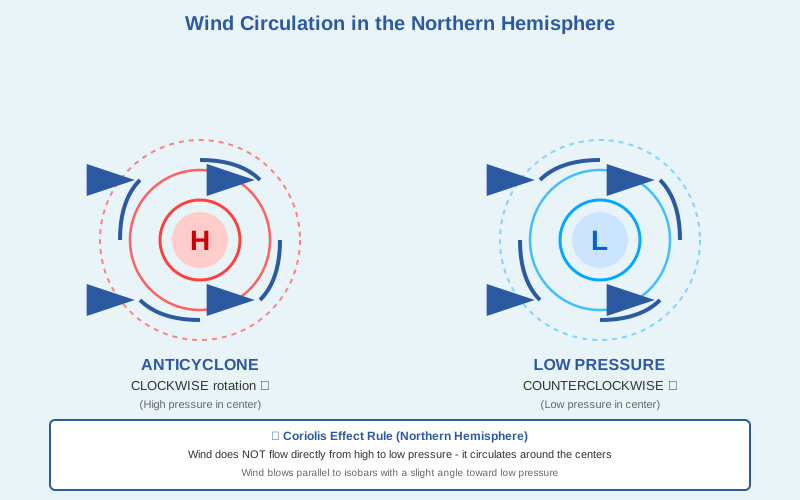
- Around a ridge: Clockwise (Northern Hemisphere)
- Around a trough: Counterclockwise (Northern Hemisphere)
Step 4: Assess Wind Intensity
The closer the contour lines, the stronger the wind. If you see very tight contour lines, expect strong winds.
Step 5: Analyze System Movement
Forecast maps show how systems will move. Generally, at mid-latitudes (like Spain), systems move from west to east.
Typical Situations Affecting Seville
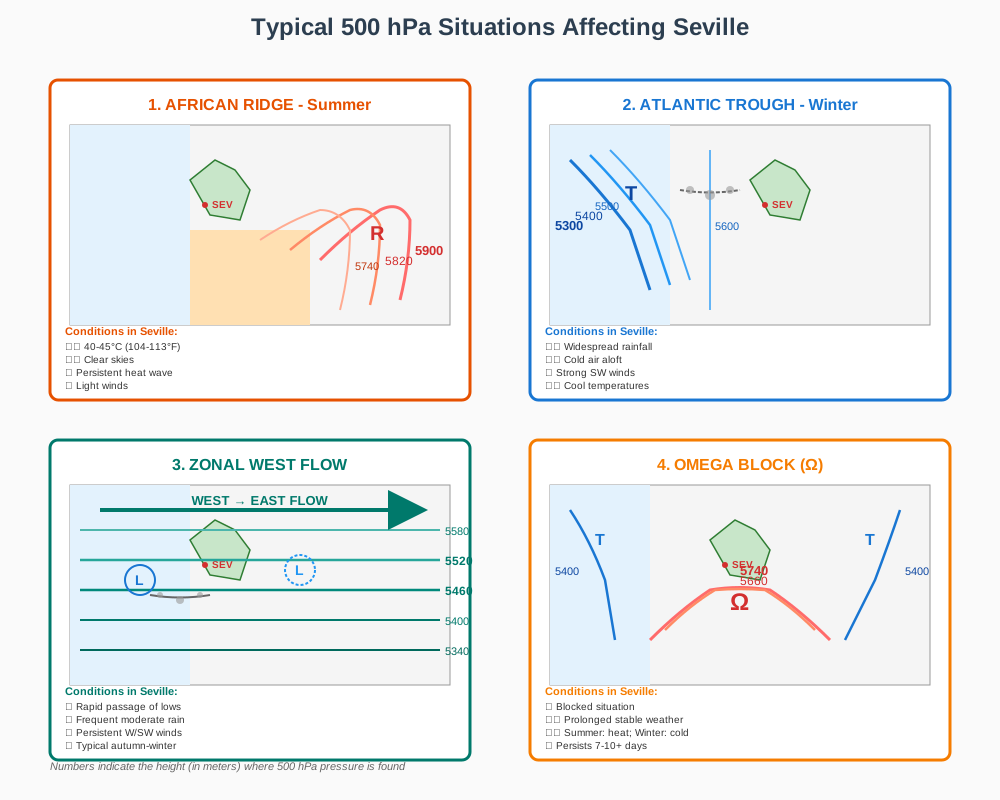
Situation 1: African Ridge in Summer
Map: Powerful ridge centered over Morocco/Algeria. Geopotential over Seville: 5,900+ meters.
Forecast for Seville:
- 🌡️ Intense heat wave (40-45°C)
- ☀️ Completely clear skies
- 🔥 Very dry air
- ⏱️ Persistent situation (several days)
Situation 2: Atlantic Trough in Winter
Map: Deep trough entering from the west. Geopotential over Seville: 5,300-5,400 meters.
Forecast for Seville:
- 🌧️ Widespread rainfall
- ❄️ Cold air aloft (possible snow in nearby mountains)
- 💨 Strong southwest wind
- 📊 Significant precipitation accumulations
Situation 3: Zonal West Flow
Map: Nearly parallel contour lines oriented west to east. Geopotential over Seville: 5,450-5,550 meters.
Forecast for Seville:
- 🌧️ Rapid passage of Atlantic storms
- 🔄 Variable but predictable weather
- 💧 Frequent but moderate rainfall
- 💨 West/southwest winds
- 🌡️ Mild temperatures (Atlantic air inflow)
- 📅 Typical of autumn-winter
Situation 4: Omega Block (Ω)
Map: Omega configuration: troughs on both sides and central ridge over the Peninsula.
Forecast for Seville:
- 🔒 Blocked and persistent situation
- ☀️ Prolonged stable weather
- 🌡️ In summer: extreme heat; in winter: temperature inversion
- ⏳ Can last 7-10 days or more
Relationship Between 500 hPa and Temperature
500 hPa maps often include isotherms (lines of equal temperature). For Seville:
- -10°C or warmer at 500 hPa: Warm air mass, stable weather
- -15°C to -20°C: Normal air mass for the season
- -25°C or colder: Very cold air intrusion, instability
Time Evolution: 3-7 Day Forecast
The real value of 500 hPa maps is seeing their evolution:
- D+0 (Today): Where are the troughs and ridges?
- D+3 (In 3 days): How have they moved? Are they approaching or moving away?
- D+5 to D+7: What general pattern is established?
Differences Between Analysis and Forecast
- Analysis Map: Based on actual observations (radiosondes). Shows current situation.
- Forecast Map: Generated by numerical models (GFS, ECMWF). Shows future scenarios.
Beyond 5-7 days, the reliability of the 500 hPa level decreases, but it still gives an idea of the expected general pattern.
Common Errors When Interpreting 500 hPa Maps
- Forgetting the surface: A 500 hPa map alone is not enough. Always relate it to what's happening at the surface.
- Not considering movement speed: A fast trough causes less rain than a slow one.
- Ignoring trough orientation: A SW-NE trough affects differently than a W-E one.
- Confusing values: 5,700 geopotential meters ≠ 5,700 meters above sea level. It's the height where we find 500 hPa.
- Not assessing depth: A shallow trough (5,500 m) is less active than a very deep one (5,200 m).
Resources to Consult 500 hPa Maps
- Wetterzentrale: Historical archive and GFS/ECMWF forecasts
- NOAA/NCEP: Official GFS maps
- ECMWF: Deterministic and ensemble forecasts
- Windy.com: Interactive visualization of 500 hPa with isotachs
- Meteociel: Analysis and forecasts for Europe
Combining 500 hPa with Other Levels
For professional forecasts, meteorologists analyze several levels:
- 850 hPa (~1,500 m): Temperature and humidity reaching the surface
- 700 hPa (~3,000 m): Mid level, important for instability
- 500 hPa (~5,500 m): General synoptic pattern (what we've seen)
- 300 hPa (~9,000 m): Polar jet stream
Practical Exercise
📚 To practice:
- Check a 500 hPa map for tomorrow
- Identify if there's a trough or ridge over the Iberian Peninsula
- Note the geopotential value over Seville
- Make your weather forecast
- Check tomorrow if you were right
Repeat this for a week and you'll see your predictive ability improve.
Conclusion
Geopotential maps at 500 hPa are like an "X-ray" of the middle atmosphere. While surface maps tell you what's happening now, 500 hPa maps explain why it's happening and what's going to happen.
Mastering this level requires practice, but once you achieve it, you'll be able to anticipate weather changes several days in advance. The key is understanding that troughs bring instability and ridges bring stability, and that the position of the jet determines the trajectory of systems.
🎓 Next step: Now that you understand both surface maps and 500 hPa maps, you can start relating them to each other. That's the real secret of professional weather forecasting.
Want to start with the basics? Read our isobar maps guide first before continuing with this one.
Check our weather forecasts for Seville updated daily.
Meteoensevilla.es - Weather Education Center