











Weather Models: GFS and ECMWF
Have you ever seen one model predict rain while another says sun? Weather models are powerful but imperfect tools. In this guide, you'll learn what they are, how they work, which ones to use depending on the situation, why they sometimes fail, and how to interpret them like a professional meteorologist.
What is a Weather Model?
A weather model is a computer program that simulates the atmosphere using complex physical and mathematical equations.
How It Works (Simplified)
- Observation: Data is collected from stations, balloons, aircraft, satellites, ships...
- Analysis: A "3D map" of the current state of the atmosphere is created
- Simulation: The supercomputer calculates how the atmosphere will evolve using physics
- Output: Maps of pressure, temperature, rain, wind... for each future hour
The Main Weather Models
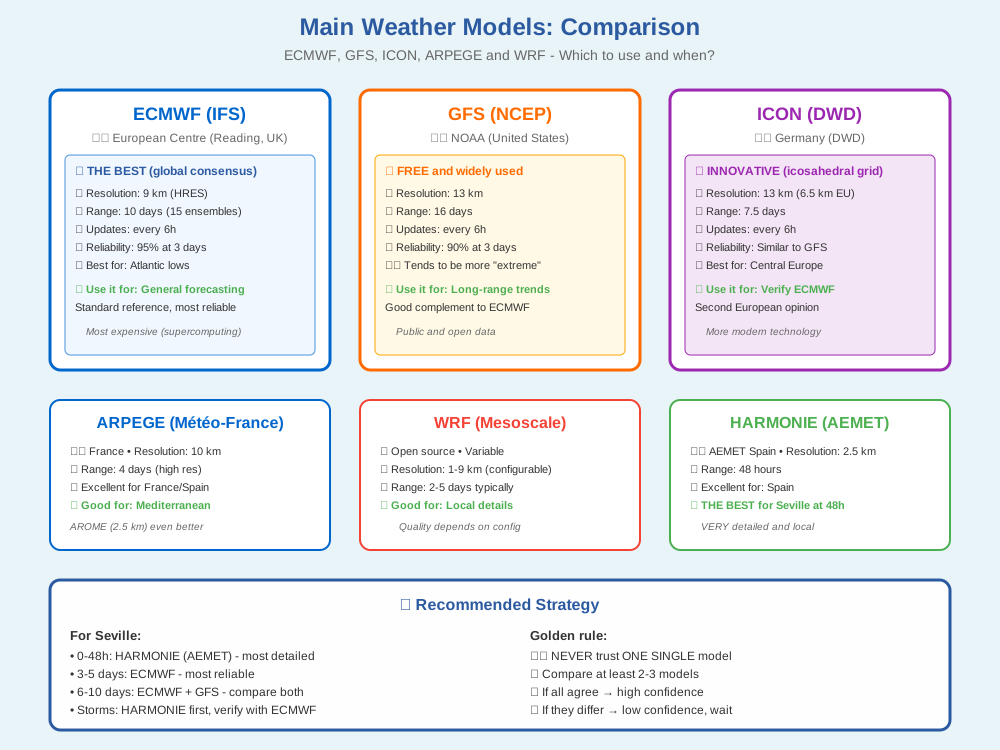
1. ECMWF (European Centre for Medium-Range Weather Forecasts)
The "king" of models
Characteristics:
- 🇪🇺 **European Centre (ECMWF)**: Scientific headquarters in **Reading (United Kingdom)** and operational centres in **Bologna (Italy)** and **Bonn (Germany)**.
- **Resolution**: 9 km (HRES - High Resolution).
- **Range**: 10 days (15 days for ensembles).
- **Updates**: Every 6 hours (00Z, 06Z, 12Z, 18Z).
- **Supercomputer**: Located at its data centre in **Bologna (Italy)**, it is one of the most powerful in the world.
Why it's the best:
- More input data (superior assimilation)
- More sophisticated atmospheric physics
- Better for Atlantic storms
- Reliability: ~95% at 3 days, ~85% at 5 days, ~70% at 7 days
When to use it: As your main REFERENCE. If ECMWF says A and others say B, trust ECMWF more (although it's not always right).
2. GFS (Global Forecast System)
The American model - Free and widely used
Characteristics:
- 🇺🇸 NOAA (United States)
- Resolution: 13 km (previously 28 km)
- Range: 16 days (the longest)
- Updates: Every 6 hours
- FREE - Completely open data
Advantages:
- Public and accessible data for everyone
- Very long range (16 days vs 10 for ECMWF)
- Good for general trends
Disadvantages:
- Tends to be more "extreme" (exaggerates cold/heat/rain)
- Less reliable than ECMWF at medium range
- Changes more from one run to another
When to use it: To see TRENDS at 7-15 days, but don't trust the details. Use it as a complement to ECMWF.
3. ICON (Icosahedral Non-hydrostatic)
The German model - Innovative
Characteristics:
- 🇩🇪 DWD (German Weather Service)
- Resolution: 13 km global, 6.5 km Europe
- Range: 7.5 days (120 hours high resolution)
- Technology: Icosahedral grid (innovative)
Advantages:
- More modern technology than ECMWF/GFS
- Better resolution in Europe (6.5 km)
- Very good for Germany/Central Europe
When to use it: As a second European opinion. If ECMWF and ICON agree, high confidence.
4. ARPEGE / AROME (Météo-France)
The French model - Excellent for Spain
ARPEGE:
- 🇫🇷 Météo-France
- Resolution: 10 km
- Range: 4 days (high resolution)
- Very good for France, Spain, Mediterranean
AROME:
- Resolution: 2.5 km (very detailed!)
- Range: 42 hours
- Excellent for storms, local effects
- Covers France and northern Spain
When to use it: For short-term forecasting (0-48h) in Spain, especially Mediterranean.
5. HARMONIE-AROME (AEMET)
The Spanish model - THE BEST for Seville short-term
Characteristics:
- 🇪🇸 AEMET (State Meteorological Agency)
- Resolution: 2.5 km (super detailed!)
- Range: 48 hours
- Updates: Every 6 hours
- Based on French AROME, adapted to Spain
Advantages:
- Very high resolution = local details
- Better Spanish topography (mountain ranges, valleys)
- Excellent for convective storms
- Official for Spain
When to use it: For Seville at 0-48 hours, it's your BEST option. After 48h, switch to ECMWF.
6. WRF (Weather Research and Forecasting)
The open-source model - Variable
Characteristics:
- 🌍 Open source (NCAR/NOAA)
- Resolution: Configurable (1-36 km typical)
- Range: Variable (2-5 days typical)
- Used by universities, private companies
Note: Quality depends GREATLY on who configures it. A well-configured WRF can be excellent; a poorly configured one, disastrous.
Recommended Strategy for Seville
🎯 Practical guide by timeframe:
0-48 hours (today and tomorrow):
- 1st HARMONIE-AROME (AEMET) - 2.5 km, the most detailed
- 2nd ECMWF HRES - Verification
- 3rd ARPEGE/AROME - Second opinion
3-5 days:
- 1st ECMWF - The most reliable
- 2nd ICON - Complement
- 3rd GFS - Trends
6-10 days:
- 1st ECMWF Ensembles - Uncertainty
- 2nd GFS - Comparison
- ⚠️ Don't trust details, only TRENDS
10-15 days:
- Only very general trends
- Reliability ~50-60% (little better than chance)
- Useful for very preliminary planning
Why Models Sometimes Fail
No model is perfect. Here are the 5 main reasons for their errors:
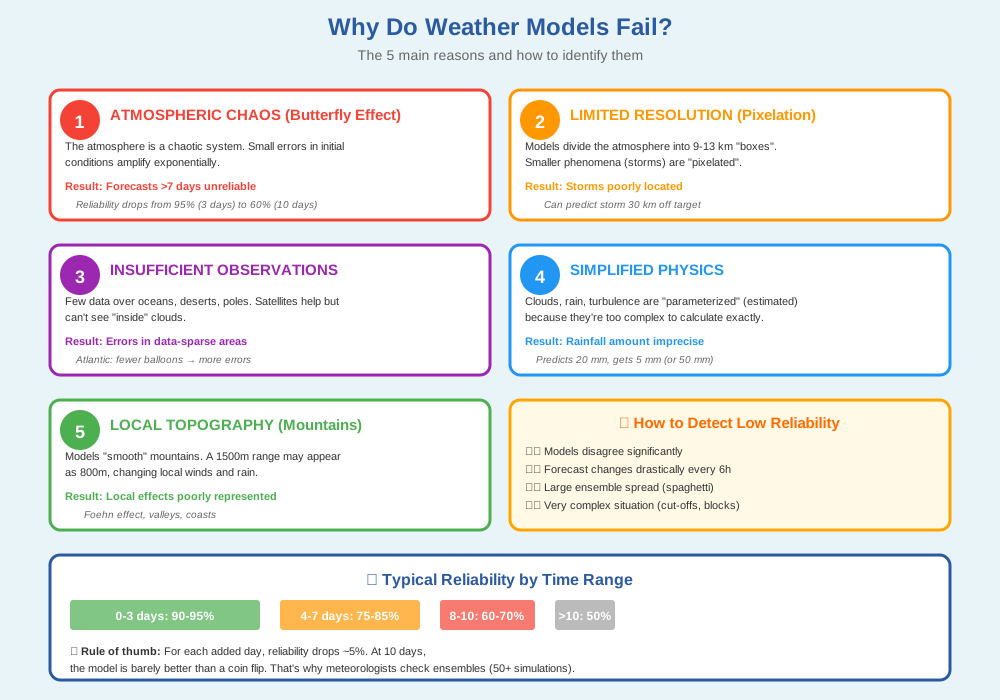
REASON 1: Atmospheric Chaos (The Butterfly Effect)
The fundamental problem:
The atmosphere is a chaotic system. Tiny errors in initial conditions amplify exponentially over time.
Example: A 0.1°C error in air temperature over the Atlantic can, in 7 days, become a 5°C error and 200 km displacement in a storm's position.
Consequence: Reliability drops ~5% for each added day. That's why at 10+ days, the model is barely better than chance.
REASON 2: Limited Resolution ("Pixelation")
The problem:
Models divide the atmosphere into "boxes" of 9-13 km. Smaller phenomena (individual 5 km storms) are "pixelated" or ignored.
Example: An 8 km diameter storm may appear as a 20 km diffuse patch, located 30 km away from where it will actually be.
Consequence: The EXACT location of storms is unreliable. The model may correctly predict "there will be storms in the Seville area," but not whether your specific neighborhood will get wet.
REASON 3: Insufficient Observations
The problem:
Models need data on the current state of the atmosphere. But over oceans, deserts, and poles there is LITTLE data.
Example: Over the central Atlantic there may be only 10 weather balloons per day covering millions of km². Satellites help, but don't see "inside" clouds nor measure wind directly.
Consequence: Storms forming in the Atlantic may have errors in their initial intensity or trajectory.
REASON 4: Simplified Physics (Parameterizations)
The problem:
Some atmospheric processes (cloud formation, turbulence, rain) are too complex or too small to calculate directly. They are "estimated" with simplified formulas called parameterizations.
Example: The exact amount of rain a cloud produces depends on millions of microscopic droplets. The model uses statistical formulas to estimate it.
Consequence: Rain AMOUNT is very imprecise. The model may correctly predict it will rain, but be wrong about whether it will be 10 mm or 50 mm.
REASON 5: Local Topography ("Smoothed" Mountains)
The problem:
Models "smooth" mountains. A 1500m mountain range may appear as an 800m hill in the model.
Example: Sierra de Cazorla (2000m) appears as ~1200m in a 13 km model. This changes how wind flows, where it rains, and where foehn effects occur.
Consequence: Local effects (valleys, coastal breezes, foehn effect) poorly represented.
How to Interpret Model Maps
Meteorologists don't just look at numbers. They know how to "read between the lines." Here's your guide:
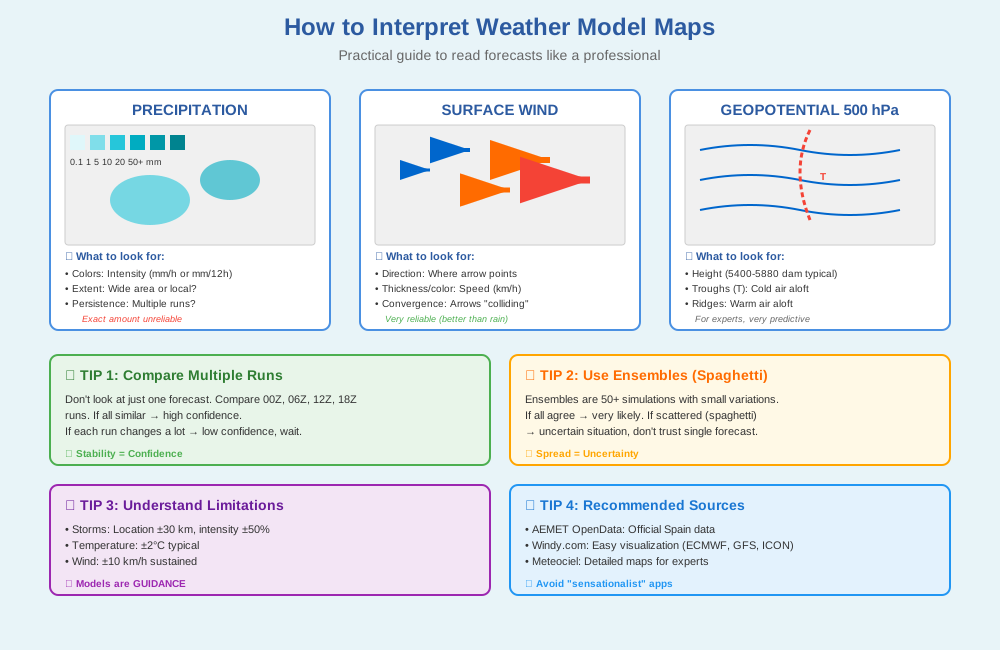
Precipitation Map
What it shows: Accumulated rain (mm/h, mm/12h, mm/24h)
How to interpret it:
- Color/intensity: Light blue = drizzle, dark blue = moderate rain, green/yellow = heavy, red = torrential
- Extent: Wide area or small patch? Small patches are less reliable (isolated storms)
- Persistence: Does it appear in several model runs? If yes = more likely
Limitations:
- ❌ Exact amount not very reliable (margin ±50%)
- ❌ Precise location of storms ±20-30 km
- ✓ General trend IS reliable (will rain/won't rain)
Wind Map
What it shows: Surface wind (10m height) or upper levels
How to interpret it:
- Arrows: Where the wind BLOWS to (not where it comes from)
- Color/thickness: Speed - blue = light, yellow = moderate, red = strong
- Convergence: Arrows that "collide" = rising air = possible clouds/rain
Limitations:
- ✓ VERY reliable (better than rain)
- ✓ Direction almost always correct
- ⚠️ Gusts can be 30-50% stronger than sustained wind
500 hPa Geopotential Map
What it shows: Height (in meters) where pressure is 500 hPa (~5.5 km altitude)
How to interpret it:
- High numbers (5700-5880 dam): Warm air aloft (anticyclone, ridge)
- Low numbers (5200-5500 dam): Cold air aloft (trough, cut-off low)
- Troughs (V): "Dips" to the south = instability
- Ridges: "Bulges" to the north = stability
Why it's useful:
The 500 hPa geopotential is VERY predictive. If you see a deep trough approaching, expect bad weather even if it's not visible at the surface yet.
Practical Tips for Using Models
1. NEVER Trust a Single Model
ALWAYS compare 2-3 models:
- If ECMWF, GFS, and ICON agree → High confidence
- If they differ a lot → Low confidence, wait for updates
- If one says rain and another sun → Uncertain situation, check ensembles
2. Compare Multiple Runs (00Z, 06Z, 12Z, 18Z)
Models are updated every 6 hours. Look at 2-3 consecutive runs:
- If all similar → Stable prediction = reliable
- If each run changes a lot → Unstable prediction = unreliable
Example: If the 00Z run predicts rain on Wednesday, then the 06Z removes it, and 12Z puts it back... Don't trust it! Wait for it to stabilize.
3. Use Ensembles (Probabilistic Forecasting)
Ensembles are 50+ simulations with small variations in initial conditions.
How to interpret them:
- If all members agree → 95%+ probability
- If there's moderate spread → 70-80% probability
- If very spread out ("spaghetti plot") → Low confidence
Example: If 45 of 50 members predict rain, it's very likely to rain. If 25 say rain and 25 say sun, flip a coin.
4. Understand Limitations by Variable
Reliable variables:
- ✓ Temperature: ±1-2°C typical
- ✓ Pressure: Very reliable
- ✓ Wind (direction): Very reliable
- ✓ Wind (speed): ±10 km/h typical
Less reliable variables:
- ⚠️ Rain amount: ±50% easily
- ⚠️ Exact location of storms: ±30 km
- ⚠️ Snow (rain/snow boundary): ±200m elevation
- ⚠️ Fog: Very difficult to predict
Recommended Sources to Consult Models
For General Users
- Windy.com: Excellent visual interface, ECMWF/GFS/ICON models, free
- AEMET (aemet.es): Official forecasts for Spain, very reliable at 1-3 days
- Meteoensevilla.es: 😉 Local interpretation for Seville
For Advanced Users
- Meteociel.fr: Detailed maps, many models, free
- Wetterzentrale.de: Classic maps, historical archive
- Tropical Tidbits: Excellent for detailed analysis
- AEMET OpenData: Official raw data (requires technical knowledge)
Apps to Avoid
⚠️ Be careful with:
- Apps that predict "exact rain" at 15 days (impossible)
- Apps that change forecast every hour (use AI without physical basis)
- "Sensationalist" apps (exaggerated red alerts for clicks)
Trust official sources (AEMET) and known models (ECMWF, GFS, ICON).
Conclusion
Weather models are incredibly powerful tools that have revolutionized weather forecasting. But they are not magic crystal balls.
Remember:
- Models are INDICATIVE, not absolute
- Always compare 2-3 models before deciding
- Reliability drops dramatically after 7 days
- For Seville: HARMONIE (0-48h) → ECMWF (3-10 days)
- Use ensembles to understand uncertainty
- Professional meteorologists never trust a single model
💡 Final advice: Learn to interpret models yourself. Don't just rely on app forecasts. Look at Windy.com or Meteociel, compare ECMWF with GFS, see if there's consensus. You'll understand MUCH better what weather is coming and with what confidence. You'll be your own meteorologist!
Did you find this guide useful? Also check our guides on Isobar Maps, Cut-off Lows and Fronts and Storms.